Showing posts with label Pope Francis. Show all posts

Thursday, December 5, 2013

Read The Socialist Pope

Well, I always said that Jesus was a Socialist Hippie -

Alan Grayson e-mailed this:  "It hurts me to say this, but I recognize that I'm not the only one who says things that are worth listening to. So, from time to time, I'm going to turn over this "bully pulpit" to someone else. Today, I turn it over to someone who knows a thing or two about pulpits, Pope Francis. A week ago, he released his first apostolic exhortation, called "The Joy of the Gospel." I respectfully request that you take a few moments to read an excerpt from it, below. I found it fascinating, and I think that you will, too.


No to an economy of exclusion

Just as the commandment "Thou shalt not kill" sets a clear limit in order to safeguard the value of human life, today we also have to say "thou shalt not" to an economy of exclusion and inequality. Such an economy kills. How can it be that it is not a news item when an elderly homeless person dies of exposure, but it is news when the stock market loses two points? This is a case of exclusion. Can we continue to stand by when food is thrown away while people are starving? This is a case of inequality. Today everything comes under the laws of competition and the survival of the fittest, where the powerful feed upon the powerless. As a consequence, masses of people find themselves excluded and marginalized: without work, without possibilities, without any means of escape.

Human beings are themselves considered consumer goods to be used and then discarded. We have created a "throw-away" culture which is now spreading. It is no longer simply about exploitation and oppression, but something new. Exclusion ultimately has to do with what it means to be a part of the society in which we live; those excluded are no longer society's underside or its fringes or its disenfranchised - they are no longer even a part of it. The excluded are not the "exploited" but the outcast, the "leftovers".

In this context, some people continue to defend trickle-down theories which assume that economic growth, encouraged by a free market, will inevitably succeed in bringing about greater justice and inclusiveness in the world. This opinion, which has never been confirmed by the facts, expresses a crude and naïve trust in the goodness of those wielding economic power and in the sacralized workings of the prevailing economic system. Meanwhile, the excluded are still waiting. To sustain a lifestyle which excludes others, or to sustain enthusiasm for that selfish ideal, a globalization of indifference has developed. Almost without being aware of it, we end up being incapable of feeling compassion at the outcry of the poor, weeping for other people's pain, and feeling a need to help them, as though all this were someone else's responsibility, and not our own. The culture of prosperity deadens us; we are thrilled if the market offers us something new to purchase. In the meantime all those lives stunted for lack of opportunity seem a mere spectacle; they fail to move us.

No to the new idolatry of money

One cause of this situation is found in our relationship with money, since we calmly accept its dominion over ourselves and our societies. The current financial crisis can make us overlook the fact that it originated in a profound human crisis: the denial of the primacy of the human person! We have created new idols. The worship of the ancient golden calf (cf. Exodus 32:1-35) has returned in a new and ruthless guise, in the idolatry of money and the dictatorship of an impersonal economy lacking a truly human purpose. The worldwide crisis affecting finance and the economy lays bare their imbalances and, above all, their lack of real concern for human beings; man is reduced to one of his needs alone: consumption.

While the earnings of a minority are growing exponentially, so too is the gap separating the majority from the prosperity enjoyed by those happy few. This imbalance is the result of ideologies which defend the absolute autonomy of the marketplace and financial speculation. Consequently, they reject the right of states, charged with vigilance for the common good, to exercise any form of control. A new tyranny is thus born, invisible and often virtual, which unilaterally and relentlessly imposes its own laws and rules. Debt and the accumulation of interest also make it difficult for countries to realize the potential of their own economies, and keep citizens from enjoying their real purchasing power. To all this we can add widespread corruption and self-serving tax evasion, which have taken on worldwide dimensions. The thirst for power and possessions knows no limits. In this system, which tends to devour everything which stands in the way of increased profits, whatever is fragile, like the environment, is defenseless before the interests of a deified market, which become the only rule.

No to a financial system which rules rather than serves

Behind this attitude lurks a rejection of ethics and a rejection of God. Ethics has come to be viewed with a certain scornful derision. It is seen as counterproductive, too human, because it makes money and power relative. It is felt to be a threat, since it condemns the manipulation and debasement of the person. In effect, ethics leads to a God who calls for a committed response which is outside the categories of the marketplace. When these latter are absolutized, God can only be seen as uncontrollable, unmanageable, even dangerous, since he calls human beings to their full realization and to freedom from all forms of enslavement. Ethics - a non-ideological ethics - would make it possible to bring about balance and a more humane social order. With this in mind, I encourage financial experts and political leaders to ponder the words of one of the sages of antiquity: "Not to share one's wealth with the poor is to steal from them and to take away their livelihood. It is not our own goods which we hold, but theirs". [Saint John Chrysostom, De Lazaro Concio, II, 6: PG 48, 992D.]

A financial reform open to such ethical considerations would require a vigorous change of approach on the part of political leaders. I urge them to face this challenge with determination and an eye to the future, while not ignoring, of course, the specifics of each case. Money must serve, not rule! The Pope loves everyone, rich and poor alike, but he is obliged in the name of Christ to remind all that the rich must help, respect and promote the poor. I exhort you to generous solidarity and to the return of economics and finance to an ethical approach which favors human beings.

No to the inequality which spawns violence . . . .

Today's economic mechanisms promote inordinate consumption, yet it is evident that unbridled consumerism combined with inequality proves doubly damaging to the social fabric. Inequality eventually engenders a violence which recourse to arms cannot and never will be able to resolve. It serves only to offer false hopes to those clamoring for heightened security, even though nowadays we know that weapons and violence, rather than providing solutions, create new and more serious conflicts. Some simply content themselves with blaming the poor and the poorer countries themselves for their troubles; indulging in unwarranted generalizations, they claim that the solution is an "education" that would tranquilize them, making them tame and harmless. All this becomes even more exasperating for the marginalized in the light of the widespread and deeply rooted corruption found in many countries - in their governments, businesses and institutions - whatever the political ideology of their leaders.

To which I simply wish to add:

Amen,

Rep. Alan Grayson
P.S. For more on this, please visit us at CongressmanWithGuts.com."


Thursday, March 14, 2013

Do I Give a Sh*t About The Pope?

I ask myself, Do I Give a Sh*t About The Pope?

When I was about 12, my Grandfather, an amiable old guy who enjoyed life, didn't work too hard, and attended a High Anglican, not Roman Catholic, Church, went to Rome.  With his jolly English Church group, he stood with thousands of others in St Peter's Square, to be waved at by a very old guy in a dress.

(For a hilarious take on Church vestments as a fashion show, check out the great Italian Director Federico Fellini's "Roma" -

)


Dear old Pop sent home a postcard of the cheering crowd at St Peter's, with his personal report of seeing the Pope on the balcony: "He's such a good man". 

I was just a kid, but I had a questioning mind, and I remember thinking, "How does he know he's a good man?  Has he met him?"

I feel about the same when I watch the hoopla on the media about the selection of the new incumbent to be head of this strange organization.  I don't believe in God, I definitely don't believe that the Pope, always old, always frail, usually Italian, is the chosen voice of God, divinely selected in an unbroken line from Jesus' buddy, Peter.  Years ago I learned that the Roman Church is the largest holder of stocks and shares in the world; if that's no longer true, I'm sure it's still a contender.  Is that how you do the work of God, by amassing the largest fortune in the world, while your flock includes millions of the poorest people on the planet?

(As I point out in my Book Proposal, "The War On The 60s", Jesus can be very well described as a Hippie Socialist.)

Why is the secular, non-Catholic media always fascinated by the pomp and circumstance of a discredited organization?  An organization which is at the center of a foul scandal of child rape?  Which is known to have helped many leading Nazis to escape justice at the end of Word War 2?

My only guess so far, is that they want to be on the right side of an Establishment institution, and in the process, bolster that Establishment's grip on the minds of the masses worldwide.  Wonderful!


The respected investigative journalist, Robert Parry, who exposed Ollie North and Iran-Contra, and won a Polk Award, has been digging into the past career of their new Pope, who's chosen to take the name of another flower child, Francis of Assisi:

‘Dirty War’ Questions for Pope Francis

March 13, 2013
Exclusive: The U.S. “news” networks bubbled with excitement over the selection of Argentine Cardinal Jorge Bergoglio to be Pope Francis I. But there was silence on the obvious question that should be asked about any senior cleric from Argentina: What was Bergoglio doing during the “dirty war,” writes Robert Parry.

By Robert Parry (Updated March 14, 2013, to delete incorrect reference to Bergoglio in Guardian article)
If one wonders if the U.S. press corps has learned anything in the decade since the Iraq War – i.e. the need to ask tough question and show honest skepticism – it would appear from the early coverage of the election of Pope Francis I that U.S. journalists haven’t changed at all, even at “liberal” outlets like MSNBC.
The first question that a real reporter should ask about an Argentine cleric who lived through the years of grotesque repression, known as the “dirty war,” is what did this person do, did he stand up to the murderers and torturers or did he go with the flow. If the likes of Chris Matthews and other commentators on MSNBC had done a simple Google search, they would have found out enough about Cardinal Jorge Bergoglio to slow their bubbling enthusiasm.

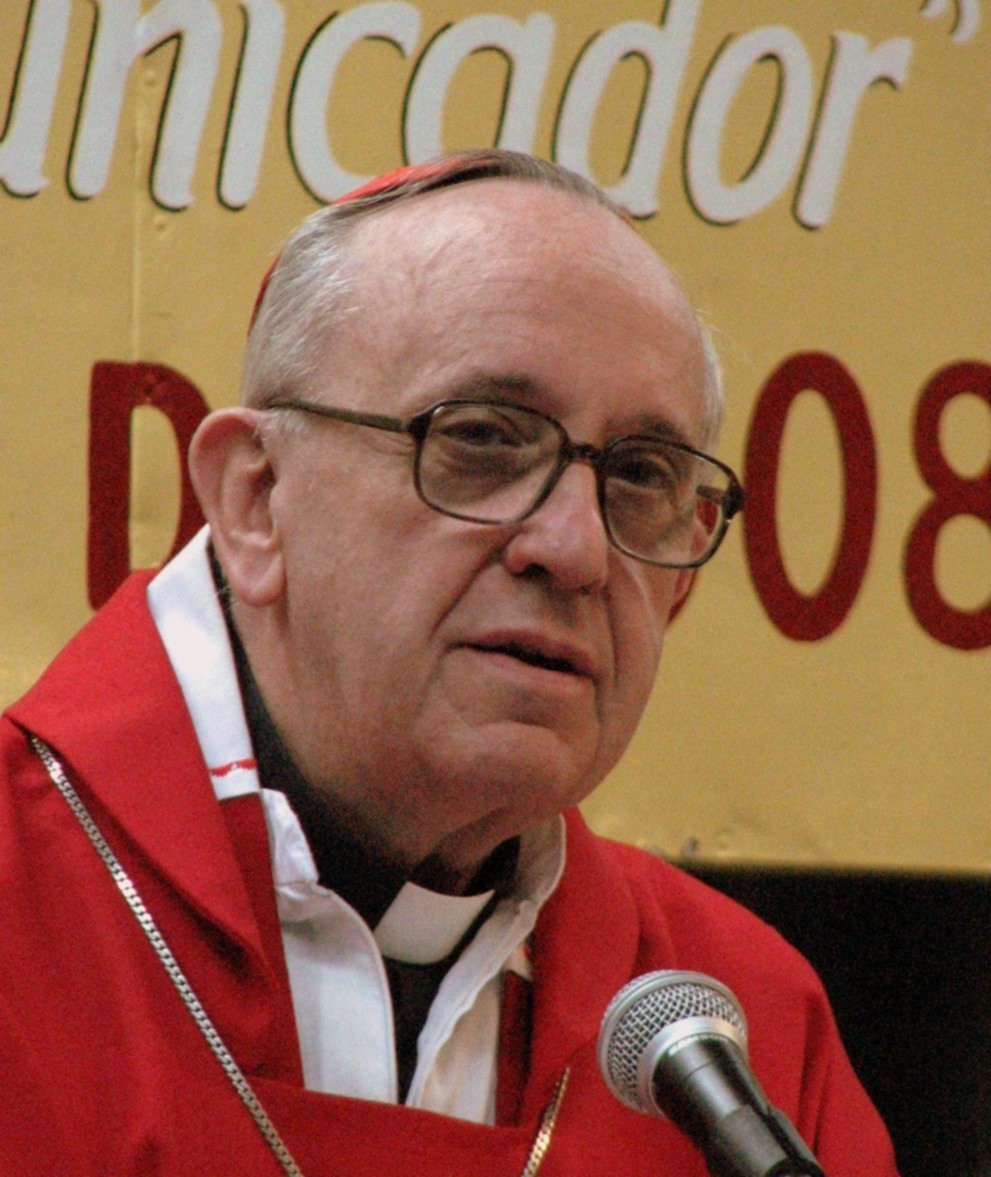
Cardinal Jorge Bergoglio, now Pope Francis I, in 2008. (Photo credit: Aibdescalzo)
Bergoglio, now the new Pope Francis I, has been identified publicly as an ally of Argentine’s repressive leaders during the “dirty war” when some 30,000 people were “disappeared” or killed, many stripped naked, chained together, flown out over the River Plate or the Atlantic Ocean and pushed sausage-like out of planes to drown.
The “disappeared” included women who were pregnant at the time of their arrest. In some bizarre nod to Catholic theology, they were kept alive only long enough to give birth before they were murdered and their babies were farmed out to military families, including to people directly involved in the murder of the babies’ mothers.
Instead of happy talk about how Bergoglio seems so humble and how he seems so sympathetic to the poor, there might have been a question or two about what he did to stop the brutal repression of poor people and activists who represented the interests of the poor, including “liberation theology” priests and nuns, during the “dirty war.”
Here, for instance, is an easily retrievable story from Guardian columnist Hugh O’Shauhnessy from 2011, which states:
“To the judicious and fair-minded outsider it has been clear for years that the upper reaches of the Argentine church contained many ‘lost sheep in the wilderness’, men who had communed and supported the unspeakably brutal Western-supported military dictatorship which seized power in that country in 1976 and battened on it for years.
“Not only did the generals slaughter thousands unjustly, often dropping them out of aeroplanes over the River Plate and selling off their orphan children to the highest bidder, they also murdered at least two bishops and many priests. Yet even the execution of other men of the cloth did nothing to shake the support of senior clerics, including representatives of the Holy See, for the criminality of their leader General Jorge Rafael Videla and his minions.
“As it happens, in the week before Christmas [2010] in the city of Córdoba Videla and some of his military and police cohorts were convicted by their country’s courts of the murder of 31 people between April and October 1976, a small fraction of the killings they were responsible for. The convictions brought life sentences for some of the military.
“These were not to be served, as has often been the case in Argentina and neighbouring Chile, in comfy armed forces retirement homes but in common prisons. Unsurprisingly there was dancing in the city’s streets when the judge announced the sentences.
“What one did not hear from any senior member of the Argentine hierarchy was any expression of regret for the church’s collaboration … in these crimes. The extent of the church’s complicity in the dark deeds was excellently set out by Horacio Verbitsky, one of Argentina’s most notable journalists, in his book El Silencio (Silence),” which alleges Bergoglio’s complicity in human right abuses.
The Guardian article stated: “The most shaming thing for the church is that in such circumstances Bergoglio’s name was allowed to go forward in the ballot to chose the successor of John Paul II. What scandal would not have ensued if the first pope ever to be elected from the continent of America had been revealed as an accessory to murder and false imprisonment.
“One would have thought that the Argentine bishops would have seized the opportunity to call for pardon for themselves and put on sackcloth and ashes as the sentences were announced in Córdoba but that has not so far happened. … Cardinal Bergoglio has plenty of time to be measured for a suit of sackcloth – perhaps tailored in a suitable clerical grey.”
Now, instead of just putting forward Bergoglio’s name as a candidate for Pope, the College of Cardinals has actually elected him. Perhaps the happy-talking correspondents from the U.S. news media will see no choice but to join in the cover-up of what Pope Francis did during the “dirty war.” Otherwise, they might offend some people in power and put their careers in jeopardy.
In contrast to the super-upbeat tone of American TV coverage, the New York Times did publish a front-page analysis on the Pope’s conservatism, citing his “vigorous” opposition to abortion, gay marriage and the ordination of women. The Times article by Emily Schmall and Larry Rohter then added:
“He was less energetic, however, when it came to standing up to Argentina’s military dictatorship during the 1970s as the country was consumed by a conflict between right and left that became known as the Dirty War. He has been accused of knowing about abuses and failing to do enough to stop them while as many as 30,000 people were disappeared, tortured or killed by the dictatorship."